


Pharmaceutical Print Compliance: What You Need to Know Before You Go to Press
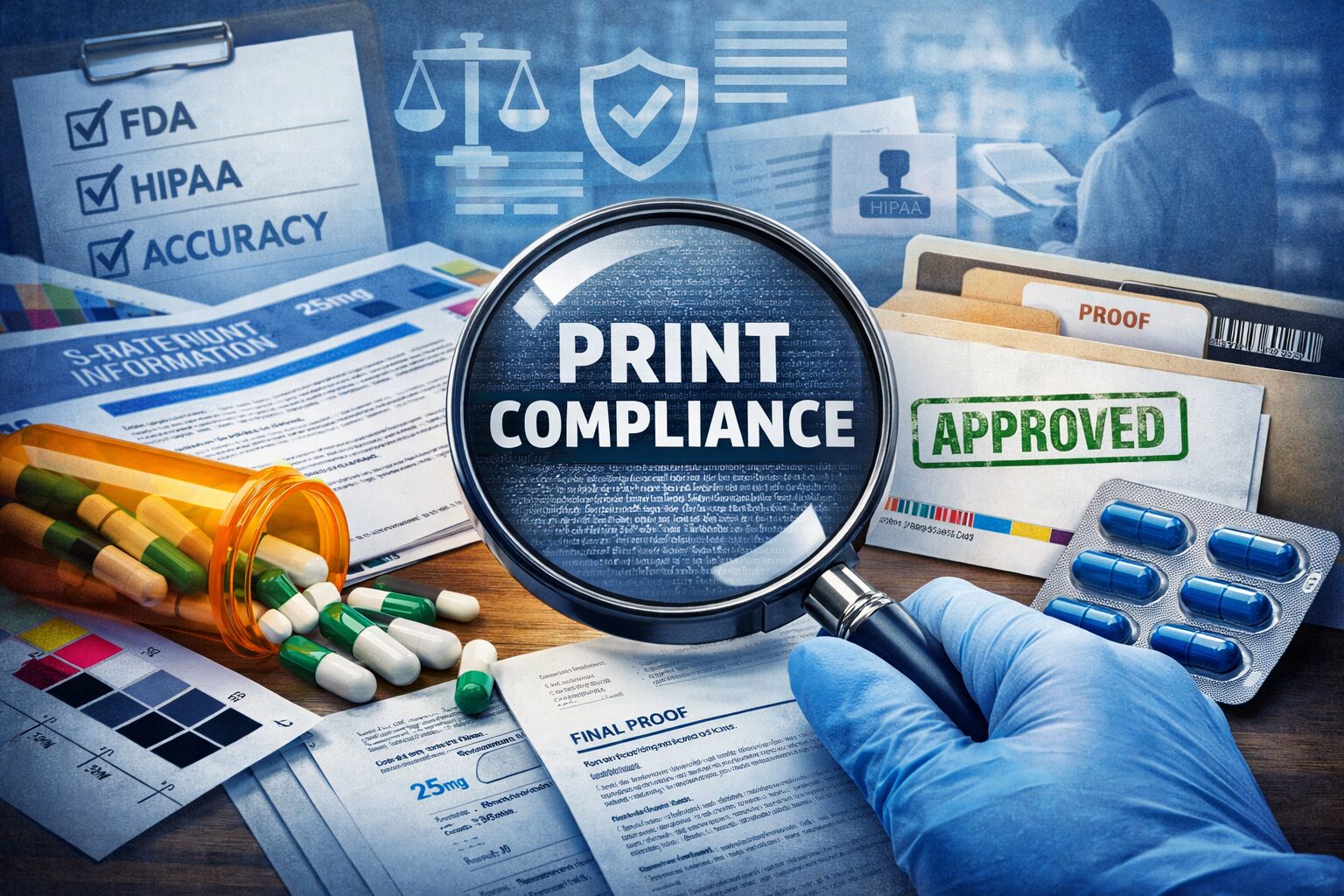
In the world of pharmaceutical marketing, your print materials are more than just brand assets—they are legal documents. Compliance is the boundary between a successful campaign launch and a massive regulatory liability. Whether you are producing patient education guides or clinical trial recruitment flyers, you aren’t just managing a print run; you are managing risk.
Defining the Compliance Hand-off
It is important to establish a clear line of ownership: The brand owner and their regulatory/legal teams are responsible for the clinical and legal accuracy of the content. At Graphic Solutions Group, our role is the flawless execution of those approved materials. While we provide the technical safeguards and certified workflows to prevent production-level errors, the compliance review of the copy, claims, and ISI must be finalized before files are released to the press.
Here is how to lock down your process before a single drop of ink hits the paper.
Why Pharmaceutical Print Compliance Matters
In pharma, print remains a critical touchpoint. It appears in:
- Patient Education Materials
- Direct Mail Campaigns
- Clinical Trial Recruitment
- Packaging Inserts
- Sales Collateral
Each piece must meet strict standards from the Food and Drug Administration (FDA) and other governing bodies. If it doesn’t, you risk heavy fines, pulled campaigns, and damage to brand trust. In the worst-case scenario, patient safety is impacted. No printer or marketing team wants to be the weak link in that chain.
1. Accuracy Is Non-Negotiable
This is the baseline. Every printed piece must match approved content exactly. This includes drug names, dosages, and safety disclaimers.
Common failure points:
- Outdated PDFs sent to the press.
- Last-minute “minor” edits that bypass the re-approval process.
- Version control breakdowns between creative and production teams.
The Fix: Lock files before production, use a “single source of truth” for assets, and require a final physical or digital sign-off from the compliance team before the run begins.
2. Regulatory Requirements You Can’t Ignore
Pharma print must align with standards from the FDA, FTC, and industry groups like PhRMA. Key requirements include:
- Fair Balance: Risks and benefits must be presented with equal prominence.
- Important Safety Information (ISI): No hiding critical safety data in tiny type or obscure layouts.
- Clear Claims: All benefits must be substantiated and never exaggerated.
If your layout buries the ISI, it’s a compliance violation—even if the copy itself is technically correct.
3. Data Privacy and HIPAA Considerations
If your print project involves patient data—even just a name and mailing address—it falls under the jurisdiction of the Health Insurance Portability and Accountability Act (HIPAA).
The “Business Associate” Requirement
In these cases, your printer is legally considered a “Business Associate.” To remain compliant, you must ensure your partner provides:
- Business Associate Agreements (BAA): A signed contract clarifying their legal obligation to protect Protected Health Information (PHI).
- Secure File Transfer: Utilizing encrypted SFTP portals rather than standard email.
- Physical Security: Controlled access to the production floor where sensitive data is processed.
- Defined Retention & Destruction: Documented protocols for shredding “spoils” and purging digital data after the job is complete.
4. Color Accuracy and G7 Standard
In pharma, color isn’t just aesthetic; it’s a functional requirement. Color can signal brand identity, product differentiation, and instructional clarity. Inconsistent color across print runs can create patient confusion and trigger internal rejections.
To ensure consistency, work with a partner that prints to the G7 Master Standard. This calibration ensures that your output remains identical whether it is printed via:
- Offset (Large runs)
- Digital (Small batches/Variable data)
- Large Format (Event signage)
5. Material Selection and Durability
Compliance doesn’t stop at the content. If a piece fails physically, it fails the job. Pharmaceutical print often needs to perform in high-traffic environments like waiting rooms, hospitals, and labs.
Choose materials wisely:
- Tear-resistant stocks for frequent-use inserts.
- Writable surfaces for patient intake forms.
- Durable coatings for materials that will be handled by multiple staff members.
6. Audit Trails and Documentation
If a regulatory body questions a campaign months after the fact, you must be able to “show your work.” Your documentation should include:
- Approval records with timestamps.
- Version history showing the evolution of the piece.
- Print production logs that prove exactly what was shipped.
7. Choosing the Right Print Partner
Not every printer is equipped for the rigors of pharmaceutical print compliance. You need a partner who understands regulated workflows, maintains strict version control, and follows secure data handling practices.
At Graphic Solutions Group, this level of precision is part of our daily operations. From prepress through final fulfillment, our goal is simple: no surprises, no compliance gaps.
Final Thought
Pharmaceutical print compliance is a chain. The brand owner provides the approved content, and Graphic Solutions Group provides the controlled execution. When both sides are locked in, the result is a product that is safe, effective, and legally sound. Visit Graphic Solutions Grouphome.com/contact — let’s build a plan that keeps your marketing moving.
Graphic Solutions Group is a full-service commercial printer serving businesses across the country from our facility in the metro Atlanta area. We specialize in business print, direct mail, display graphics, brand promotions, and inventory management programs.
Start here:
👉 https://www.gsghome.com
Contact Us for More Information
Are you looking for a printer who can help you meet your deadlines?
Then your in the right place! Have any questions or concerns we would love to hear from you.
Please submit your information in this form and a sales professional will reach out to you.
Want to Speak to a Sales Representative? Call 770-424-2300