


Printed Calendars That Get Used: 7 Formats Beyond Wall Calendars
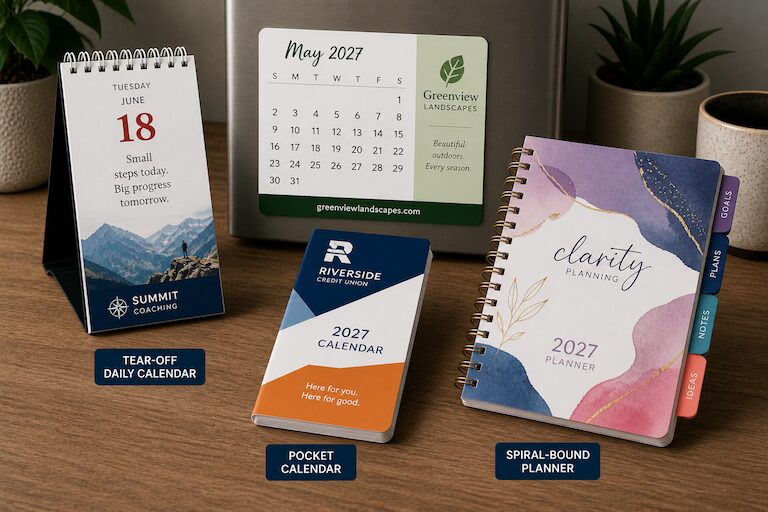
Printed calendars still work because people use them. They sit on desks, hang in work areas, ride along in pockets, and land in mailboxes at the right time of year.
The problem is that many businesses default to a standard wall calendar without thinking through how their audience will use it.
A better question is simple:
Where will this calendar live, and how often will someone look at it?
When you match the format to the setting, your calendar has a much better chance of being kept, used, and seen for months. That is where printed calendars can still deliver real value.
Here are seven calendar formats worth considering.
1. Desk Pad Calendars: Built for Daily Use
Desk pad calendars sit where work gets done.
They give people a month-at-a-glance layout with room for notes, reminders, deadlines, and quick planning. For office users, that makes them practical. For your brand, it means daily visibility without asking for attention.
Desk pad calendars work well for:
- Professional service firms
- Financial offices
- Real estate teams
- B2B sales organizations
- Customer service desks
- Internal company planning
They also give you plenty of room for branding without making the piece feel like an ad. A clean logo, useful contact information, and a simple message can do the job.
For businesses already ordering sales sheets, brochures, forms, and other everyday materials, desk pad calendars fit well into a larger business printing program.
2. Tear-Off Daily Calendars: A New Touchpoint Every Day
Tear-off calendars create daily interaction.
Each page gives you a chance to share a tip, reminder, quote, promotion, safety message, product note, or useful fact. That daily reset keeps the piece fresh and gives your audience a reason to come back to it.
These are a strong fit for:
- Gyms and wellness brands
- Schools and education programs
- Healthcare offices
- Nonprofits
- Safety programs
- Employee engagement campaigns
The key is to make the content useful. A daily calendar should not be 365 sales pitches. Mix in helpful reminders, simple ideas, seasonal notes, and light promotional messaging.
That balance makes people keep using it.
3. Magnetic Calendars: Small, Useful, and Easy to Keep
Magnetic calendars usually land on refrigerators, filing cabinets, warehouse boards, or office metal surfaces.
That makes them useful for local businesses that want repeat visibility. They do not take up much space, they are easy to mail or hand out, and they tend to stay where people can find them.
Magnetic calendars are a good choice for:
- HVAC companies
- Plumbers and electricians
- Restaurants
- Medical offices
- Dental offices
- Schools
- Community organizations
- Local service providers
They work best when the design is clean. Put the calendar, logo, phone number, website, and one clear reason to call. Do not overpack it.
For businesses that need calendars as part of a larger neighborhood or customer campaign, magnetic calendars can pair well with full-service direct mail.
4. Pocket Calendars: Simple, Portable, and Easy to Hand Out
Pocket calendars are basic, but that is the point.
They are small, inexpensive, easy to distribute, and useful for people who want a quick date reference without carrying a planner. They can fit in a wallet, glovebox, checkbook cover, welcome packet, or event bag.
Pocket calendars are useful for:
- Banks and credit unions
- Insurance agencies
- Senior services
- Healthcare providers
- Government offices
- Membership organizations
- Churches and community groups
These also work well when paired with appointment cards, loyalty cards, wallet inserts, or small promotional pieces.
For campaigns where the goal is wide distribution at a controlled cost, pocket calendars can make sense.
5. Spiral-Bound Planners: More Room for Notes, Goals, and Schedules
Spiral-bound planners give people room to plan, track, and organize.
They can include monthly views, weekly layouts, goal pages, notes, checklists, contacts, training schedules, event dates, or internal company information. The spiral binding lets the planner lay flat, which makes it easier to use at a desk, counter, or meeting table.
Planners work well for:
- Schools
- Nonprofits
- Training programs
- Sales teams
- Healthcare programs
- Dealer networks
- Employee onboarding
- Multi-location businesses
This format works best when the content has a purpose. A planner can support a program, guide a team, or help customers stay organized.
For companies that order recurring materials across teams or locations, planners can also tie into inventory management so reorders stay controlled and consistent.
6. Poster-Style Calendars: Big, Visible, and Easy to Reference
Poster calendars are made to be seen from across the room.
They are a good option for shared spaces where people need to see the same schedule, deadlines, events, or reminders. This format can be simple, bold, and effective.
Poster calendars are useful in:
- Offices
- Breakrooms
- Warehouses
- Classrooms
- Retail backrooms
- Production areas
- Event spaces
- Training rooms
They can show the full year, a quarter, a campaign timeline, or an event schedule.
When size and visibility matter, poster-style calendars fit naturally with display and graphics projects.
7. Folded Mailer Calendars: Useful Direct Mail That Sticks Around
Folded mailer calendars combine reach with usefulness.
They can mail flat, unfold into a larger calendar, and give the recipient something worth keeping. That makes them stronger than a basic postcard when your goal is longer-term brand visibility.
Folded mailer calendars work well for:
- Local service companies
- Healthcare reminders
- School calendars
- Community events
- Seasonal promotions
- Real estate farming campaigns
- Annual customer thank-you mailings
They also give you space for offers, key dates, QR codes, service reminders, or location information.
For direct mail campaigns, the calendar gives your piece a longer shelf life. Instead of getting tossed after one glance, it has a reason to stay in the home or office.
How to Choose the Right Printed Calendar Format
The best printed calendar is not always the biggest one or the most expensive one.
It is the one your audience will actually use.
Before choosing a format, ask:
- Where will this calendar be used?
- Will one person use it, or will a group reference it?
- Does it need room for notes?
- Should it be mailed, handed out, or included in a kit?
- Does it need to support appointments, reminders, promotions, or events?
- How long do you want it to stay visible?
Those answers point you toward the right format.
A desk pad may be right for office customers. A magnetic calendar may be better for homeowners. A folded mailer may work best for local outreach. A planner may fit an internal team or training program.
The format should match the job.
Printed Calendars Are Still Practical Marketing
Printed calendars work because they are useful first.
They do not depend on someone opening an app, clicking a link, or remembering where they saved something. They sit in plain sight and help people plan.
That makes them a smart fit for customer retention, direct mail, internal communication, local marketing, and annual brand visibility.
Graphic Solutions Group can help you choose the right printed calendar format, match it to your audience, and produce it as part of a larger print, promo, or display program.
If you are planning calendars for customers, employees, dealers, donors, or local prospects, contact Graphic Solutions Group and we can help you build the right version for your budget, timeline, and audience.
FAQ: Printed Calendars
Are printed calendars still effective for marketing?
Yes. Printed calendars still work when they are useful. If someone keeps the calendar on a desk, wall, refrigerator, or workspace, your brand stays visible for months.
What is the best calendar format for direct mail?
Folded mailer calendars and magnetic calendars are strong choices for direct mail. They are easy to distribute and have a higher chance of being kept than a standard sales piece.
What calendar format works best for offices?
Desk pad calendars, poster calendars, and spiral-bound planners are good options for offices. The right choice depends on how much writing space, visibility, and detail the user needs.
Can printed calendars be part of a promotional campaign?
Yes. Printed calendars can work with branded gifts, mailers, launch kits, and customer appreciation programs. They can also pair with brand promo items when you want a campaign that lasts longer than one interaction. the sales process. Contact us today to talk through your next high-stakes project.
Start here:
👉 https://www.gsghome.com
Contact Us for More Information
Are you looking for a printer who can help you meet your deadlines?
Then your in the right place! Have any questions or concerns we would love to hear from you.
Please submit your information in this form and a sales professional will reach out to you.
Want to Speak to a Sales Representative? Call 770-424-2300